News and Events
Advancing Electric Vehicles and Quantum Technology: Hung-Chung Hsueh’s Interdisciplinary Research Team Publishes in Leading International Journals
Date 2026-10-27 55 Clicks

Professor Hung-Chung Hsueh of Tamkang University's Department of Physics, along with alumnus and postdoctoral researcher Chih-En Hsu and an international research team, recently published two significant findings in the prestigious international journals Nature Chemistry and Physical Review Letters. Through international collaboration, the team not only stabilized an exotic quantum state at room temperature that previously existed only at extremely low temperatures, but also developed a new method for accurately calculating the properties of semiconductor materials. These breakthroughs lay an important foundation for the future development of electric vehicle chips and quantum computers.
In the first study, Hsueh and Hsu collaborated with research teams from the Departments of Chemistry and Biochemistry and Materials Science and Engineering at the University of California, Los Angeles (UCLA), the Department of Chemical Engineering and Materials Science at the University of Southern California (USC), and the University of Chemistry and Technology in the Czech Republic, among others. They published their findings in Nature Chemistry, a leading chemistry journal with a five-year impact factor of 24. Previously, exotic quantum phenomena in a two-dimensional layered quantum material known as "1T-TaS₂" could only be maintained at extremely low temperatures of approximately −93°C (180 K), significantly limiting its potential for practical applications.
To overcome this temperature limitation, the research team adopted an innovative "molecular engineering" strategy, intercalating arginine molecules, an amino acid, between the material's atomic layers to create a "1T-TaS₂/arginine hybrid superlattice." This approach successfully raised the temperature at which the quantum state remains stable to above room temperature (330 K), providing a novel chemical pathway for controlling the quantum states of materials.
In another study, Hsueh and Hsu collaborated with a research team led by Professor Zhenglu Li of USC, and they published their findings in Physical Review Letters, a highly regarded physics journal with a five-year impact factor of 9.3. In chips used in smartphones, computers, and electric vehicles, electron movement is affected by interactions with atomic vibrations within the material, directly influencing device operating speeds and power consumption.
Existing computational simulation methods have limitations in accurately calculating these interactions. To address this issue, the research team used a more comprehensive theoretical approach that accounts for electron interactions. Their calculations revealed that conventional methods underestimate these interactions by approximately 15% in silicon carbide, a key material used in electric vehicles. This more accurate computational method not only helps researchers identify promising high-performance materials before experiments, reducing research and development costs, but also helps select materials that extend the stable operating time of future quantum computers.
Hsueh explained that the exotic quantum phenomena exhibited by novel materials represent important fundamental research topics of shared interest in physics and chemistry. The Nature Chemistry paper brought together researchers from multiple international teams, demonstrating the highly interdisciplinary nature of materials research. The paper's subsequent citations and academic impact will also contribute to the research performance of relevant departments at Tamkang University, further strengthening the university's overall academic achievements. He added that both breakthroughs were built upon the Department of Physics' long-established expertise in theoretical and computational research. Hsueh expressed particular gratitude for Tamkang University's sustained support in providing research facilities and resources, while also recognizing Hsu's dedication to computational implementation. Looking ahead, the team plans to extend this computational methodology to a broader range of semiconductor and two-dimensional material systems, while continuing to collaborate with international partners to advance research on materials for electronic devices and quantum information technologies.
SDGs #SDG04 Quality Education #SDG09 Industry, Innovation and Infrastructure #SDG17 Partnerships for the Goals
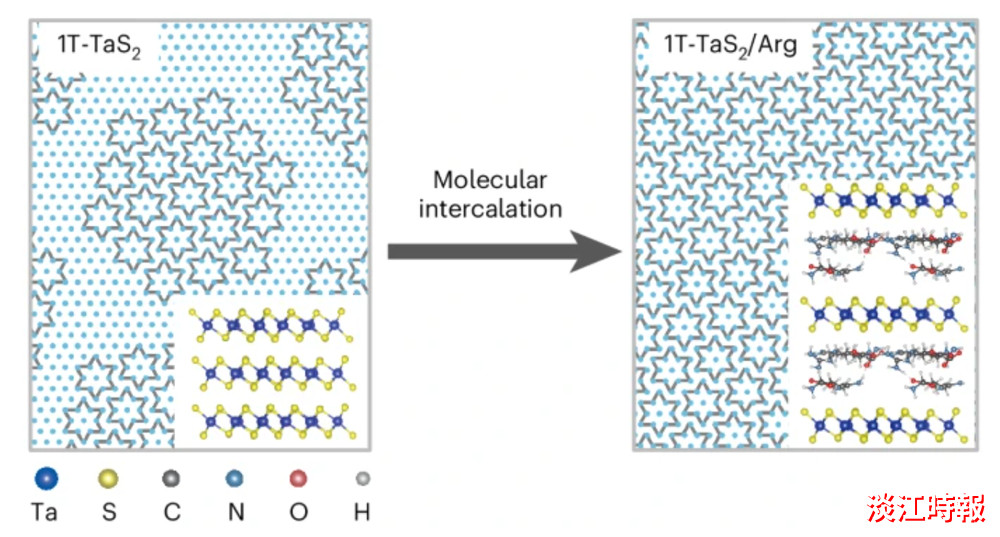
Schematic illustration of the mechanism by which a research team led by Prof. Hung-Chung Hsueh of the Physics Department intercalated arginine molecules between the atomic layers of the quantum material 1T-TaS₂, altering its internal energy states and successfully stabilizing the material's quantum state at temperatures up to 330 K.
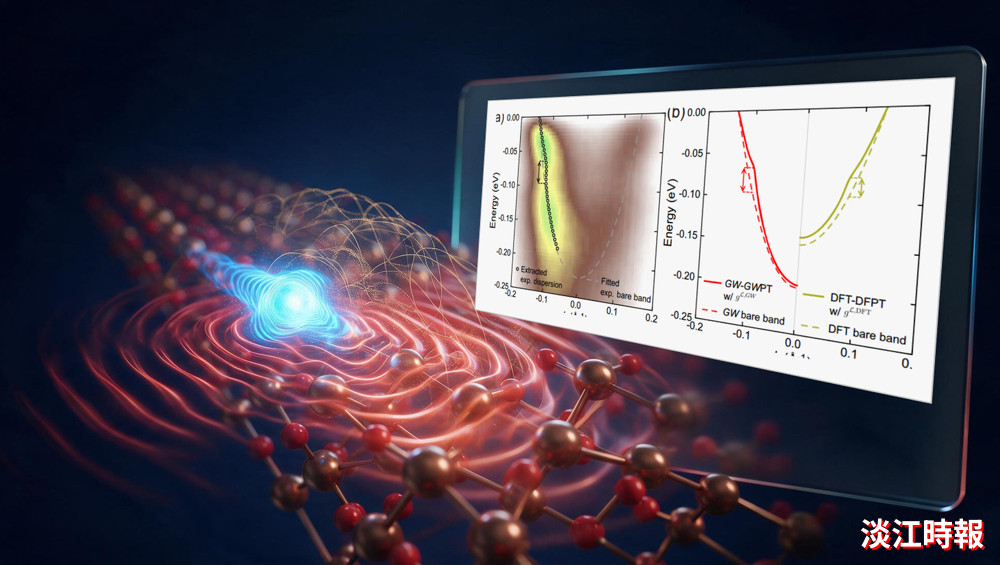
A research team led by Prof. Hung-Chung Hsueh of the Physics Department employed many-body GW perturbation theory to precisely calculate the interactions between electrons and atomic vibrations in semiconductors, validating their theoretical findings against distinctive changes observed experimentally.
LINKS
- PREV:Cultivating Critical Thinking and Empowering Learning: President Hui-Huang Hsu Shares Tamkang University’s New Vision for Education in the AI Era 2026-10-27
- Cultivating Critical Thinking and Empowering Learning: President Hui-Huang Hsu Shares Tamkang University’s New Vision for Education in the AI Era 2026-10-27
- Advancing Electric Vehicles and Quantum Technology: Hung-Chung Hsueh’s Interdisciplinary Research Team Publishes in Leading International Journals 2026-10-27
- Tamkang Hosts In-Person Instruction Week for In-service Master’s Program in Digital Learning in Asia-Pacific and Latin American Studies, Welcoming Professionals from 7 Central and South American Countries for In-Depth Exchanges 2026-10-19
- Faculty and Students Dress Up for High Table Dinner, Breaking Ice, Welcoming New Students, Fostering Connections and Cross-Cultural Exchange 2026-10-16
- Tamkang International Tourism Department Shines at Campus Golden Travel Awards, Sweeps Both National Championships in Student Category 2026-10-06
- Alumni Support Paves the Way: President Hsu Visits 5 High Schools in Kaohsiung to Discuss Deeper Collaboration 2026-10-05
- New Taipei Metro Team Meets with President Hsu to Promote the “Star Program,” Fostering Talent Development and Local Prosperity Through Collaboration 2026-10-02
- New Taipei City Advances Northern Taiwan’s Drone Industry Supply Chain as Tamkang Aerospace Engineering Department Shares Insights into Developing Key Talent 2026-10-02
- Tamkang University's 15th Board of Trustees Takes Office, Flora Chia-I Chang Reappointed Chairperson with Unanimous Support 2026-09-24
- Pioneering Contributions to Intelligent Robotics R&D, Ching-Chang Wong Honored with the 24th Y. Z. Hsu Outstanding Professor Award 2026-09-24