News and Events
Tamkang University Approved for MOEA Service Capacity Registry, Green Manufacturing Advisory Team for Metal Industry Established
Date 2026-01-23 11 Clicks

To assist industries in responding to the net-zero emissions trend and the demand for low-carbon transformation, Tamkang University has recently been officially certified under the Ministry of Economic Affairs (MOEA) Industrial Development Administration’s “Technical Service Institution Service Capacity Registration” (「技術服務機構服務能量登錄」). The University has obtained a qualification for “Green Manufacturing—Low-Carbon Process Technology Services for the Metal Industry (SD6)” (「綠色製程──金屬產業低碳製程技術服務(SD6)」). In the future, Tamkang will serve as a technical advisory unit for carbon-reduction programs related to the metal industry under the Industrial Development Administration, and will be able to leverage government resources to support companies in process improvement and industrial upgrading.
The “Green Manufacturing—Low-Carbon Process Technology for the Metal Industry” initiative is coordinated by the Office of Research and Development, while the Champion Incubation and Industry Collaboration Center serves as the primary contact window for enterprises, providing structured and professional technical services. The registered service capacity covers low-carbon process technologies for metal processing and surface treatment, including energy-saving process optimization, the introduction of low-carbon technologies, energy consumption and carbon emission analysis, as well as technical verification and advisory services. These services will help enterprises reduce process energy consumption and carbon emissions, while improving operational efficiency and sustainable competitiveness.
Dean of Research and Development Po-Shen Pan noted that Tamkang University has long been committed to industry–academia collaboration and sustainable development. In recent years, the University has actively engaged in low-carbon transformation initiatives and in-depth energy-efficiency diagnostics in industrial parks. By integrating interdisciplinary expertise from electrical engineering, chemistry, chemical and materials engineering, information management, and mechanical engineering, the Tamkang faculty have assisted numerous metal-processing and manufacturing companies in process inventory assessments, equipment efficiency evaluations, and quantitative carbon-reduction analyses, while proposing practical and feasible improvement strategies. These efforts have enabled the University to accumulate substantial hands-on advisory experience.
Shu-Han Liao, Director of the Research and Industry-Collaboration Section, pointed out that passing the service capacity registration not only signifies that the University possesses stable and institutionalized technical service capabilities, but also demonstrates that Tamkang has established a sustainable professional foundation for external services in promoting “AI+Sustainability (SDGs)” and industrial low-carbon transformation. In the future, the University will continue to deepen industry–academia collaboration through technical consulting, practical validation, and talent cultivation, helping enterprises steadily advance low-carbon manufacturing processes and sustainable operations while meeting regulatory requirements and international supply chain standards.
In recent years, Tamkang University has actively implemented its technical capabilities in Dayuan Industrial Park, New Taipei Industrial Park, and Nangang Software Park. Through the Industrial Development Administration’s Industrial Low-Carbon Transformation Program, the University has assisted companies in conducting carbon emission assessments and in-depth energy-efficiency audits. By integrating AI, big data, and Internet of Things (IoT) technologies, Tamkang has also introduced smart manufacturing solutions to help small and medium-sized enterprises address the dual challenges of digital transformation and net-zero emissions.
Currently, six advisory teams at the University are engaged in industrial park consulting programs. With the addition of faculty specializing in metal processing and green manufacturing, Tamkang has now established a seventh advisory team—the “Green Manufacturing Advisory Team for the Metal Industry”—to address the transformation needs of metal-processing companies in industrial parks. The technical service personnel certified for the low-carbon process technology services for the metal industry include Po-Shen Pan, Dean of General Affairs Ruey-Shiang Shaw, Shu-Han Liao, Assistant Professor Hsiao-Chi Hsieh from the Department of Chemical and Materials Engineering, and Assistant Professor Yen-Ting Li from the Department of Mechanical and Electro-Mechanical Engineering, demonstrating the University’s strong interdisciplinary integration capability and commitment to supporting industrial transition toward low-carbon sustainability.
SDGs #SDG04 Quality Education #SDG09 Industry, Innovation and Infrastructure #SDG17 Partnerships for the Goals
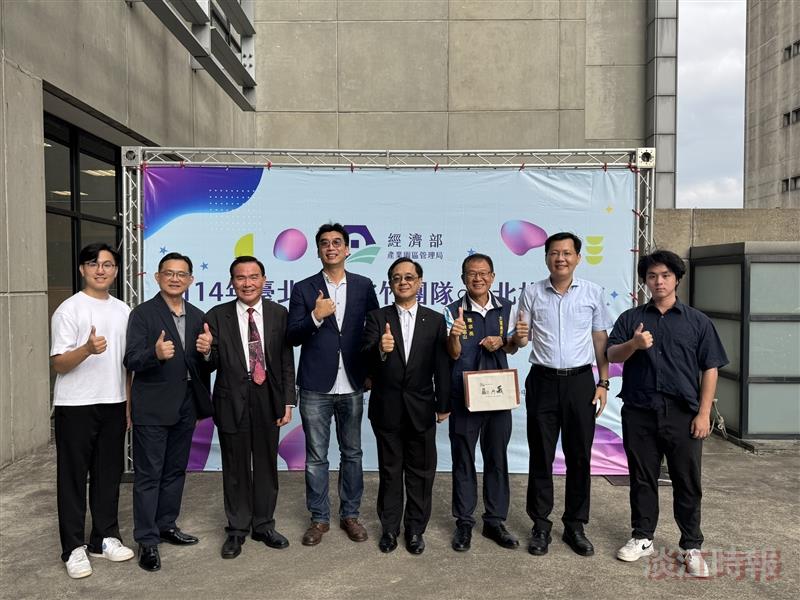
At the 2025 Dayuan Industrial Park Achievement Exhibition, staff from the Office of Research and Development posed for a group photo with You-Wen Liang (center), Director of the Taipei Branch, Bureau of Industrial Parks, Ministry of Economic Affairs.
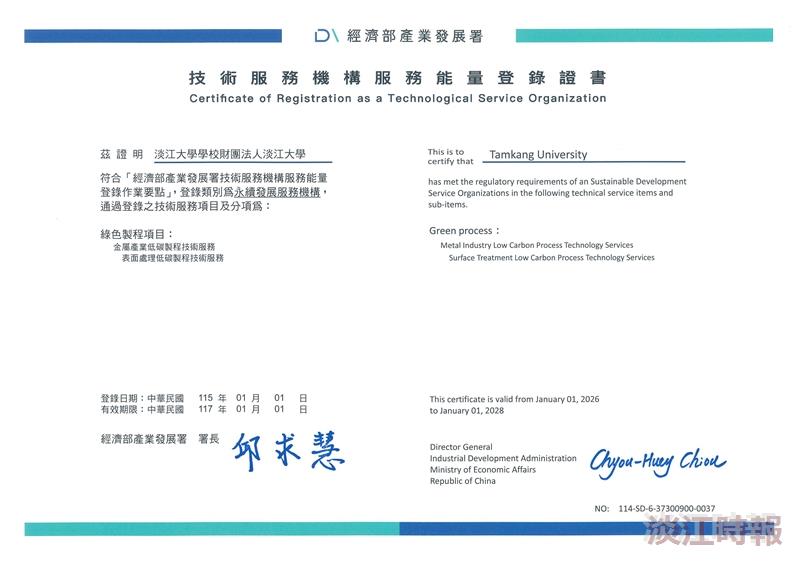
Tamkang University has been certified under the Ministry of Economic Affairs (MOEA) Industrial Development Administration’s “Technical Service Institution Service Capacity Registration”, obtaining qualification for “Green Manufacturing—Low-Carbon Process Technology Services for the Metal Industry (SD6).”
LINKS
- PREV:2026 WIN Semiconductors Contemporary Accounting Conference Spotlights In-Depth Dialogue on ESG and AI 2026-01-22
- NEXT:Earn 3 Certifications from a 2-Credit Course: 12 Engineering Students Equipped with Project Management Skills for Immediate Impact 2026-02-03
- Delta Donates NT$30 Million Digital Twin Platform to Tamkang to Cultivate Smart Manufacturing Talent 2026-02-26
- Le Corbusier World Touring Exhibition Opens in Taiwan at Tamkang University, Where Tamkang Community Composes a Poetic Dialogue of Modern Art and Architecture 2026-02-26
- Tamkang University’s Smart e-Pen and AI-Integrated Curriculum Reform Featured in International Edition of Japan’s Yomiuri Shimbun 2026-02-24
- Global Views Monthly 2026 Enterprises’ Favorite University Graduates Survey Released: Tamkang University Again Ranked No. 1 Private University Favored by Listed Companies 2026-02-24
- Earn 3 Certifications from a 2-Credit Course: 12 Engineering Students Equipped with Project Management Skills for Immediate Impact 2026-02-03
- Tamkang University Approved for MOEA Service Capacity Registry, Green Manufacturing Advisory Team for Metal Industry Established 2026-01-23
- 2026 WIN Semiconductors Contemporary Accounting Conference Spotlights In-Depth Dialogue on ESG and AI 2026-01-22
- Two Stars Shine at the Taiwan Physics Annual Meeting: Hung-Chung Hsueh and Wei-Bin Yu Recognized by Academia and Industry 2026-01-16
- CommonWealth Magazine’s ‘Companies’ Favorite' Survey: Tamkang University Ranks No. 1 Among Private Universities for a Record 29 Consecutive Years 2026-01-15
- President Keh Presents Flags to 13 Winter Service Teams, Encouraging Action-Based Social Engagement 2026-01-13