News and Events
Tamkang University’s Smart e-Pen and AI-Integrated Curriculum Reform Featured in International Edition of Japan’s Yomiuri Shimbun
Date 2026-02-24 31 Clicks

Japan’s Yomiuri Shimbun, in its international column, featured Tamkang University’s Smart e-Pen and its university-wide AI-integrated curriculum reform. The article praised Ben-Hang Chang, Director of the Carrie Chang Fine Arts Center, for his spirit of “learning at seventy,” and recognized the University’s determination to transform in the AI era, highlighting Tamkang’s forward-looking strategy and innovative leadership in AI education to the international community.
The Yomiuri Shimbun, Japan’s largest-circulation newspaper, published the column titled “Island of AI: Learning at Seventy” in its “World View” section of the international edition on February 1, 2026. Written by Seiichiro Takeuchi, an editorial board member based in Taipei, the article extensively covered the Smart e-Pen, a digital calligraphy tool developed and led by Professor Ben-Hang Chang. The report also highly praised Tamkang University’s educational strategy of fully integrating AI into its curriculum, suggesting that Japan could learn from Taiwan and Tamkang’s sense of urgency and determination in AI transformation.
The report first focuses on the Smart e-Pen, a digital calligraphy tool developed by Professor Chang, who also serves as president of the Chinese Calligraphy Society of the Republic of China. The technology has already been widely adopted in elementary schools across Taiwan. Students can use a stylus on a tablet to simulate the pressure and brushstrokes of traditional calligraphy. The article notes that the technology was further enhanced in 2025 with the integration of AI capabilities.
The article vividly describes how AI algorithms analyze the handwriting of Wang Xizhi, revered as the “Sage of Calligraphy.” The system can even compute and reconstruct the brushstroke movements that no longer exist in surviving original works, enabling students to trace and learn from reconstructed models of the master’s writing. In the interview, Chang explained that he turned from traditional ink and brush methods to digital tools out of a strong concern that calligraphy might decline if it fails to adapt to the modern era.
The report also recalls how Chang collaborated with Tzung-Hang Lee, then a professor in the College of Engineering (now the Dean), who shared the same passion for calligraphy. After repeated experimentation, they successfully developed a system capable of reproducing the strength and texture of brush strokes in 2009. To pursue further advancement, Chang decided to incorporate AI technology in 2021, when he was already over seventy years old—earning praise from the Japanese media as a model of “learning at seventy.”
Beyond the achievements of individual faculty members, Takeuchi also examined Tamkang University’s overall educational strategy. The article points out that Tamkang University shares the same sense of urgency as Professor Chang. Facing Taiwan’s declining birthrate and increasingly competitive higher education environment, the University has chosen to place its future development on the “AI revolution.”
According to the report, Tamkang University established a dedicated AI promotion unit in 2021 and introduced AI foundational courses as compulsory subjects for first-year students. The University also implemented a comprehensive policy requiring all faculty members to integrate AI technologies into their teaching. This strong awareness of technological change and decisive execution left a deep impression on the Japanese media.
The article concludes by expanding the perspective to the national level, mentioning President Ching-Te Lai’s vision of transforming Taiwan into an “AI Island.” It also reflects on Taiwan’s industrial transformation—from early development of the electronics industry to its current global leadership in semiconductors—and raises the question of whether Japan possesses the same sense of urgency as Taiwan. In an era where AI transformation is becoming increasingly essential, the examples of Taiwan and Tamkang University provide valuable lessons for Japan.
SDGs #SDG04 Quality Education #SDG09 Industry, Innovation and Infrastructure #SDG11 Sustainable Cities and Communities #SDG17 Partnerships for the Goals
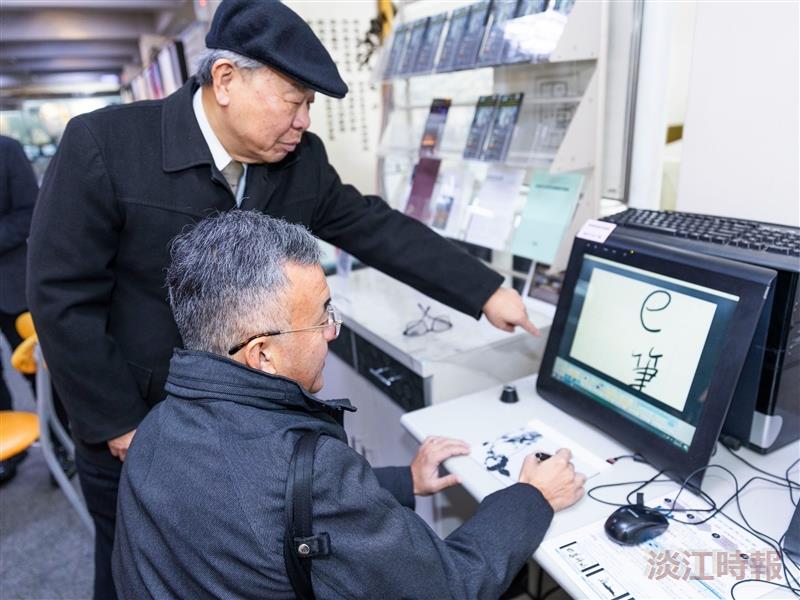
Yomiuri Shimbun correspondent in Taiwan, Seiichiro Takeuchi, experiences the Smart e-Pen; pictured on the left is Ben-Hang Chang, Director of the Carrie Chang Fine Arts Center.
LINKS
- PREV:Global Views Monthly 2026 Enterprises’ Favorite University Graduates Survey Released: Tamkang University Again Ranked No. 1 Private University Favored by Listed Companies 2026-02-24
- NEXT:Delta Donates NT$30 Million Digital Twin Platform to Tamkang to Cultivate Smart Manufacturing Talent 2026-02-26
- Delta Donates NT$30 Million Digital Twin Platform to Tamkang to Cultivate Smart Manufacturing Talent 2026-02-26
- Le Corbusier World Touring Exhibition Opens in Taiwan at Tamkang University, Where Tamkang Community Composes a Poetic Dialogue of Modern Art and Architecture 2026-02-26
- Tamkang University’s Smart e-Pen and AI-Integrated Curriculum Reform Featured in International Edition of Japan’s Yomiuri Shimbun 2026-02-24
- Global Views Monthly 2026 Enterprises’ Favorite University Graduates Survey Released: Tamkang University Again Ranked No. 1 Private University Favored by Listed Companies 2026-02-24
- Earn 3 Certifications from a 2-Credit Course: 12 Engineering Students Equipped with Project Management Skills for Immediate Impact 2026-02-03
- Tamkang University Approved for MOEA Service Capacity Registry, Green Manufacturing Advisory Team for Metal Industry Established 2026-01-23
- 2026 WIN Semiconductors Contemporary Accounting Conference Spotlights In-Depth Dialogue on ESG and AI 2026-01-22
- Two Stars Shine at the Taiwan Physics Annual Meeting: Hung-Chung Hsueh and Wei-Bin Yu Recognized by Academia and Industry 2026-01-16
- CommonWealth Magazine’s ‘Companies’ Favorite' Survey: Tamkang University Ranks No. 1 Among Private Universities for a Record 29 Consecutive Years 2026-01-15
- President Keh Presents Flags to 13 Winter Service Teams, Encouraging Action-Based Social Engagement 2026-01-13