News and Events
Tamkang University Partners with Microsoft, AMD, FET, and the Big Three Accounting Firms to Advance Dual-Track Talent Development in AI and Sustainability
Date 2026-03-04 62 Clicks

Under the witness of Minister of Education Ying-Yao Cheng, Tamkang University signed MOUs on the morning of March 4 with six leading global enterprises—Microsoft Taiwan, AMD Taiwan, Far EasTone Telecommunications, and the Big Three accounting firms PwC, EY, and KPMG—forming a strategic alliance to advance in-depth industry–academia collaboration. In his remarks, Cheng praised Tamkang’s achievements in AI and sustainability and thanked the six enterprises for investing resources to help bridge the gap between academic learning and industry needs. Following the signing ceremony, Minister of Environment Chi-Ming Peng led keynote speeches and discussions with industry leaders on green growth strategies, smart city visions, and corporate competitiveness in the AI era.
The forum, titled “Intelligent Tamsui Forum: A New Wave of AI-Driven Education,” was held at the Chang Yeo Lan Hall of the Hsu Shou-Chlien International Conference Center on the Tamsui campus. A central highlight was the industry–academia partnership signing ceremony, focusing on leveraging AI technologies and advancing sustainable development to bridge resource gaps between academia and industry. Through this collaboration, Tamkang University and its partners aim to transform theory into innovative applications and real-world practice, while implementing a dual-track talent development model aligned with market demands to achieve a win–win–win outcome for students, enterprises, and the university.
In his address, President Huan-Chao Keh noted that since 2017, Tamkang has proactively adopted the visions “AI+SDGs=∞” and “ESG+AI=∞,” integrating AI into teaching to cultivate interdisciplinary talent in AI and sustainability. He expressed hope that the forum would translate cross-disciplinary dialogue and strategic thinking into concrete action, emphasizing that such efforts represent not only technological innovation but also the realization of social value.
Minister Cheng congratulated Tamkang on its 75th anniversary and affirmed its status as a benchmark institution in Taiwan’s higher education sector. He highlighted the university’s long-standing recognition as a top private university favored by employers and its early integration of AI, cloud computing, and sustainable development (SDGs). He also commended Tamkang’s achievements in campus energy conservation and carbon reduction, as well as its contributions in sharing smart energy-saving innovations with other institutions. Cheng cited the award-winning course “AI Literacy and Thinking” by Professor Chih-Yung Chang of the Department of Computer Science and Information Engineering and Tamkang’s role as a key member of the Taiwan University AI Program Alliance. He concluded by encouraging students with the message, “AI is not meant to replace humans, but to be our most powerful assistant,” urging them to leverage technology to become future leaders in solving sustainability challenges.
Minister Peng then opened the forum with a keynote speech titled “A New Strategy for Green Growth.” He provided an in-depth analysis of Taiwan’s carbon reduction roadmap in the era of carbon pricing, noting that the carbon fee system has already driven industrial transformation, with 2,781 carbon reduction projects expected to achieve a total reduction of 47.45 million tons of emissions. He also discussed the circular economy, citing examples such as recycling coffee grounds and construction waste, as well as Taiwan’s alignment with EU regulations and green procurement policies. In addition, Peng shared practical applications of AI within the Ministry of Environment, including noise detection for modified vehicles, pollution tracing in the Keelung River, and tracking illegal waste disposal, demonstrating the effectiveness of technology-driven governance. He emphasized that “green-collar talent combined with AI” will be among the most sought-after skills in the future job market.
The second keynote was delivered by Shao-Hsin Wang, Chairman of Sinbon Electronics, on “Corporate Competitiveness in the AI Era: The Prelude to a Smart Marathon.” He discussed how AI is reshaping global industrial ecosystems, from core AI engines and energy infrastructure to advanced applications such as humanoid robots. Two executives from Sinbon’s AI team also shared practical operational experiences. Wang concluded by emphasizing that while AI is an irreversible trend, decision-making and value judgment ultimately remain in human hands, encouraging students to treat AI as a catalyst for growth and to prepare for future workplace challenges through interdisciplinary learning.
The forum concluded with a panel discussion titled “AI Leading Greater Tamsui: A Vision for Cross-Disciplinary and Sustainable Smart Cities,” moderated by Jian-Sing Li, Deputy Publisher and Editor-in-Chief of Global Views Monthly. Panelists included Shao-Hsin Wang; Pei-Wei Chiao, President of ChiaHui Group; and Roger Tseng, EY Taiwan Climate Change, Sustainability Services and ESG Advisory and Assurance Partner. Through in-depth discussion, the panelists outlined key qualities for future talent: Wang emphasized that while AI is a fundamental technological infrastructure, soft skills such as integrity, adaptability, and knowledge sharing are essential; Chiao stressed that future competitiveness lies in AI application capabilities and the ability to align with organizational goals while maintaining passion and flexibility; and Tseng, from a humanities and social sciences perspective, encouraged students to step out of their comfort zones, proactively pursue interdisciplinary learning, and integrate their expertise with emerging technologies to create new industry opportunities.
SDGs #SDG04 Quality Education #SDG07 Affordable and Clean Energy #SDG08 Decent Work and Economic Growth #SDG09 Industry, Innovation and Infrastructure #SDG11 Sustainable Cities and Communities #SDG12 Responsible Consumption and Production #SDG13 Climate Action #SDG17 Partnerships for the Goals
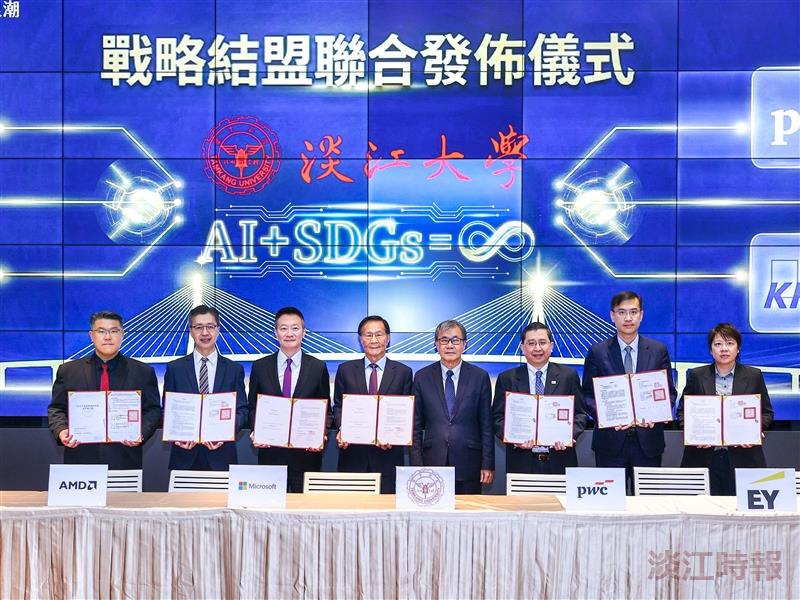
The signing ceremony was held under the witness of Minister of Education Ying-Yao Cheng (right 4th). From left to right: Peter Hu, Executive Vice President of Information and Digital Transformation Technology Group at Far EasTone Telecommunications; Wei-Chiao Huang, Senior Sales Associate Vice President at AMD Taiwan; Danny Chen, General Manager of Public Sector Business Group at Microsoft Taiwan; Huan-Chao Keh, President of Tamkang University; Minister of Education Ying-Yao Cheng; Jacky Lu, Chairman at PwC Taiwan; Roger Tseng, EY Taiwan Climate Change, Sustainability Services and ESG Advisory and Assurance Partner; and Lotus Huang, Head of KPMG ESG & Carbon Resource Assurance Team and Audit Partner of KPMG in Taiwan.
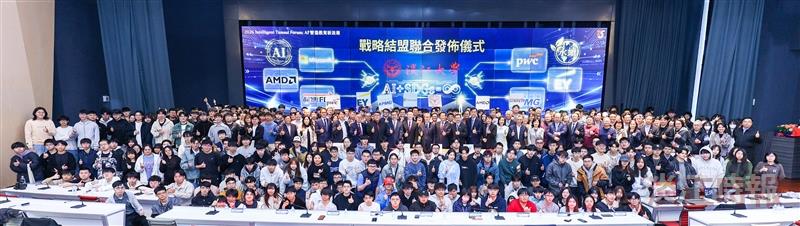
Group photo of all participants.
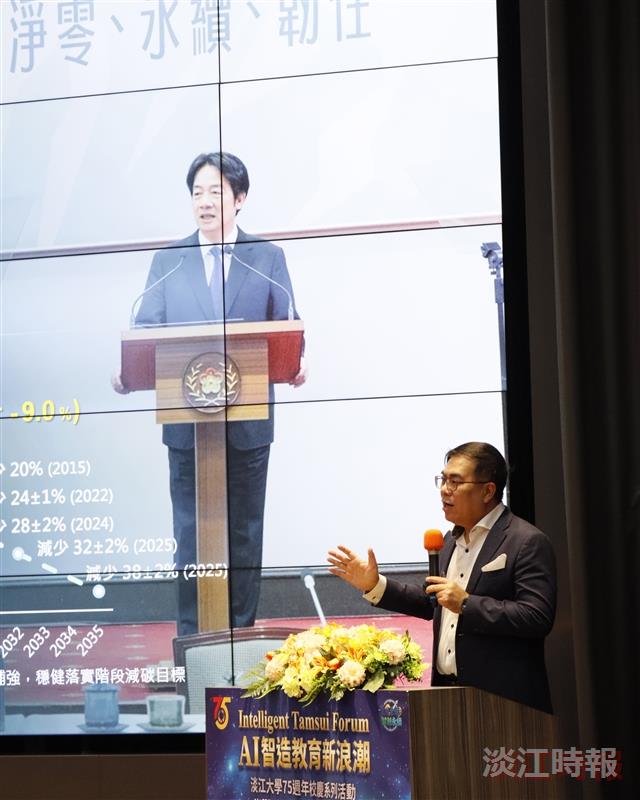
Minister of Environment Chi-Ming Peng opened the forum with a keynote speech titled “A New Strategy for Green Growth.”
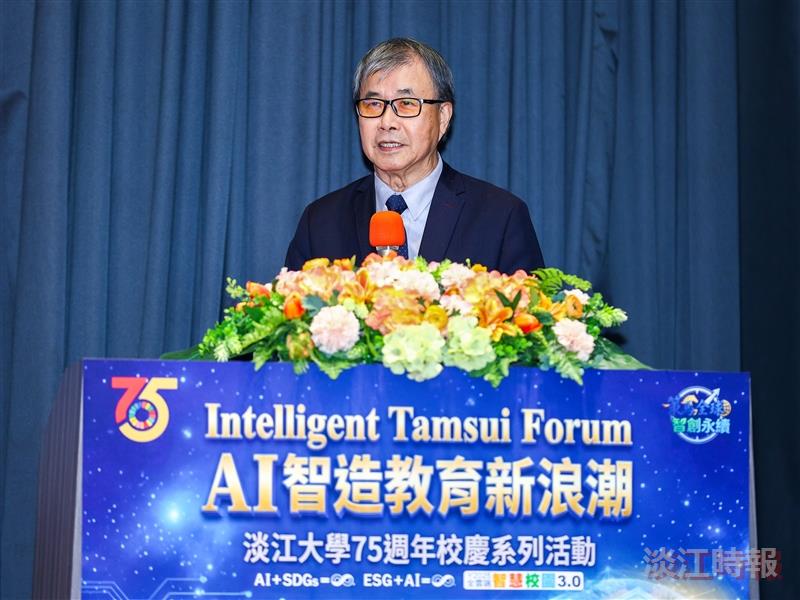
Minister of Education Ying-Yao Cheng praised Tamkang University’s outstanding governance, describing it as a benchmark institution in Taiwan.
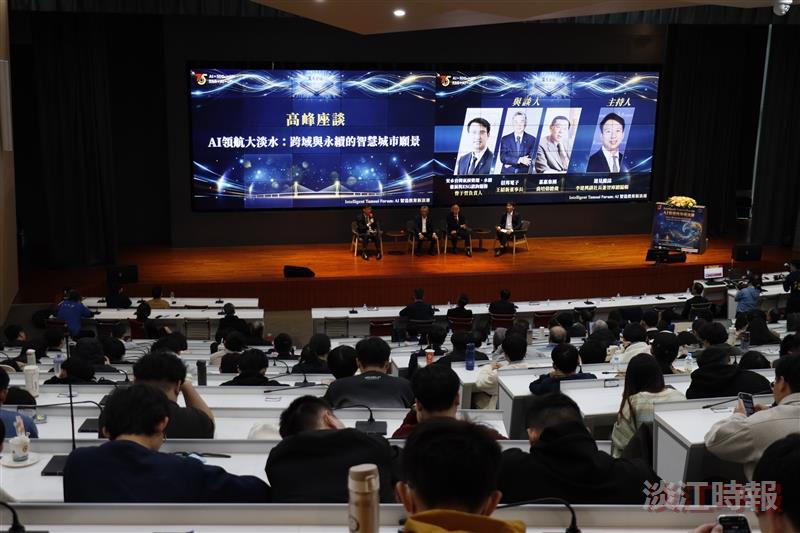
The panel discussion was moderated by Jian-Sing Li, Deputy Publisher and Editor-in-Chief of Global Views Monthly, and featured panelists including Pei-Wei Chiao, President of ChiaHui Group; Shao-Hsin Wang, Chairman of Sinbon Electronics; and Roger Tseng, EY Taiwan Climate Change, Sustainability Services and ESG Advisory and Assurance Partner.
LINKS
- PREV:Le Corbusier World Touring Exhibition Opens in Taiwan at Tamkang University, Where Tamkang Community Composes a Poetic Dialogue of Modern Art and Architecture 2026-02-26
- NEXT:Kyushu–Taiwan Visionary Institute Corporate Delegation Visits Tamkang, One-Day AI Workshop Sparks Collaboration Opportunities 2026-03-09
- Alumna’s Fluent Japanese Featured in Japanese Media, TKU Japanese Department Invites Prospective Students to Follow TSMC into Japan 2026-03-16
- College of Education Partners with University of Osaka to Advance Cross-Border Collaboration on Futures Research and Social Innovation 2026-03-12
- President Keh Leads Delegation to Visit AMD, Aiming to Deepen Industry–Academia Collaboration and Cultivate Interdisciplinary AI Talent 2026-03-11
- Department Expo Draws Over a Thousand as Students “Chase the Light” at Tamkang University 2026-03-10
- Kyushu–Taiwan Visionary Institute Corporate Delegation Visits Tamkang, One-Day AI Workshop Sparks Collaboration Opportunities 2026-03-09
- Po-Shen Pan’s Boron Compound Patent Licensed to Genhealth Pharma to Advance New Cancer Drug Development 2026-03-06
- Onomichi High School Study Group from Japan Visits Tamkang University, Fostering Cross-Cultural Exchange with Local Student Partners 2026-03-06
- Tamkang University Partners with Microsoft, AMD, FET, and the Big Three Accounting Firms to Advance Dual-Track Talent Development in AI and Sustainability 2026-03-04
- Delta Donates NT$30 Million Digital Twin Platform to Tamkang to Cultivate Smart Manufacturing Talent 2026-02-26
- Le Corbusier World Touring Exhibition Opens in Taiwan at Tamkang University, Where Tamkang Community Composes a Poetic Dialogue of Modern Art and Architecture 2026-02-26