News and Events
Kyushu–Taiwan Visionary Institute Corporate Delegation Visits Tamkang, One-Day AI Workshop Sparks Collaboration Opportunities
Date 2026-03-09 58 Clicks

Members of the Kyushu–Taiwan Visionary Institute (KTVI), led by Representative Director Naoki Kumamoto, visited Taiwan on March 6 to co-host a one-day “Japan–Taiwan Co-creation Workshop” with Tamkang University’s College of Artificial Innovative Intelligence. The event marked the kickoff activity of KTVI’s 2026 “Next-Generation Leadership Development Program.”
The seven participants who traveled to Taiwan represented diverse industries in Japan, including power, electronics, construction, and human resources. Among them were several senior executives, including Imoto Kenji, President and CEO of Workthy Inc.; Kazumasa Miura, Executive Director of Ohric Inc.; and Junichiro Eguchi, Director of Kyoei Building Partners Co., Ltd.
The Kyushu branch of KTVI, established in 2025, was created in response to TSMC’s expansion into Japan, aiming to accelerate Taiwan–Japan exchange and build a bridge for talent development. The collaboration with Tamkang College of Artificial Innovative Intelligence originated from Kumamoto’s attendance at a keynote speech delivered by Dean Tzung-Hang Lee last year. Kumamoto emphasized that in the face of rapid changes brought by AI, “rather than rushing to define AI’s role, individuals should be encouraged to actively experiment and build motivation and capability through exploration.” From a talent development perspective, he noted that AI not only enhances efficiency but also unlocks human potential; when viewed as a “partner,” AI enables innovation while reducing manpower demands.
Dean Tzung-Hang Lee, a key driver behind the workshop, stated that with the deepening collaboration in the semiconductor industry, the relationship between Taiwan and Japan’s Kyushu region has evolved from traditional tourism and trade to the forefront of global technology strategy. He expressed hope that by sharing AI development trends, cutting-edge research, and hands-on applications, the workshop would spark new opportunities for Taiwan–Japan collaboration in industrial AI transformation and jointly advance sustainability and digital transformation.
The workshop began with fundamental AI concepts and was guided by the principles of “cross-disciplinary integration, co-creation, and hands-on practice,” focusing on new forms of leadership at the intersection of AI, education, and industry. The teaching team included CIO Kuei-Ping Shih, Director Chih-Hung Chung of the Distance Education Development Center, and research assistant Jui-Lin Chang from the College of Artificial Innovative Intelligence. Participants also visited the Calligraphy Research Room, where they experienced writing with the “Smart e-Pen” under the guidance of Director Ben-Hang Chang of the Carrie Chang Fine Arts Center.
The curriculum combined conceptual understanding with practical application, introducing the concept of “Vibe Coding” and guiding participants to develop prototype tools such as a “bilingual email generator” and an “automated weekly report organizer.” From theory to hands-on implementation, participants presented their outcomes at the end of the workshop, experiencing firsthand how AI can significantly enhance workplace productivity. The workshop left a strong impression on the Japanese participants. Rijal Kiran from Shoko Electric Manufacturing praised Tamkang’s leadership in AI, noting that “such developments are still relatively rare among universities in Japan,” and highlighted the course’s rich and inspiring content on generative AI applications. Instructor Chih-Hung Chung also expressed admiration for the Japanese team’s diligence and rigor, stating, “Their eagerness to learn new technologies and their serious commitment are truly impressive.”
A major highlight of the workshop was the “TKU Copilot 3.0” real-time translation system, which enabled seamless two-way Chinese–Japanese translation throughout the program. Chung described it as “a moving breakthrough,” adding, “By conducting the entire workshop through AI-powered simultaneous translation, we successfully broke language barriers and accomplished what was once unimaginable in international teaching, demonstrating the limitless potential of AI and how technology can bring people closer together.”
SDGs #SDG04 Quality Education #SDG08 Decent Work and Economic Growth #SDG09 Industry, Innovation and Infrastructure #SDG17 Partnerships for the Goals
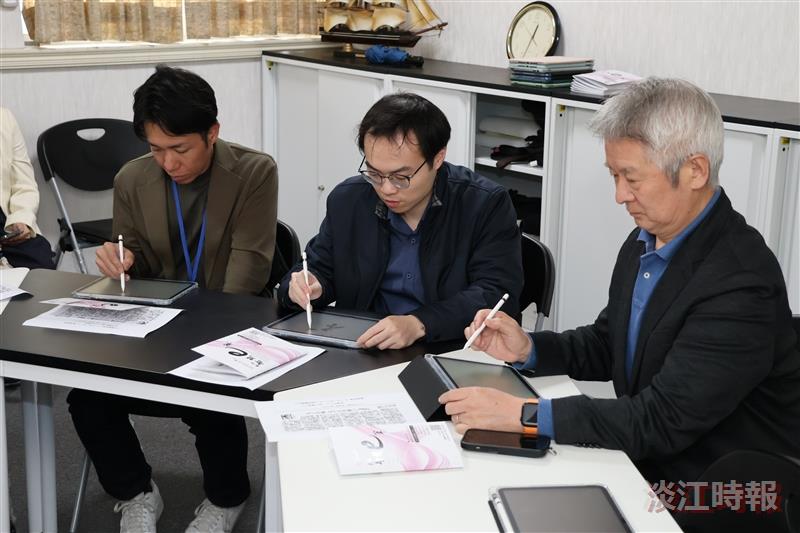
KTVI members experience writing with the “Smart e-Pen.”
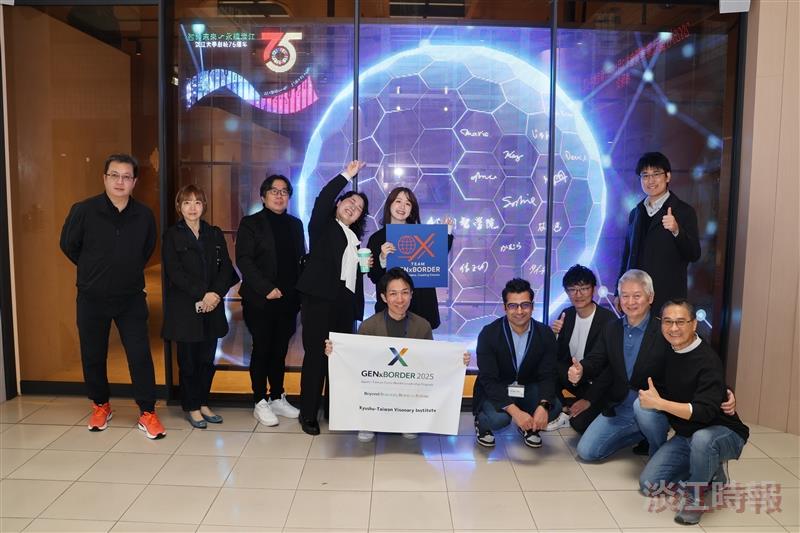
Naoki Kumamoto (front row, right 2nd), representative director of the Kyushu–Taiwan Visionary Institute (KTVI), led a delegation to Tamkang University for a one-day “Japan–Taiwan Co-creation Workshop.” In the front row, far right, is Dean Tzung-Hang Lee of the College of Artificial Innovative Intelligence.
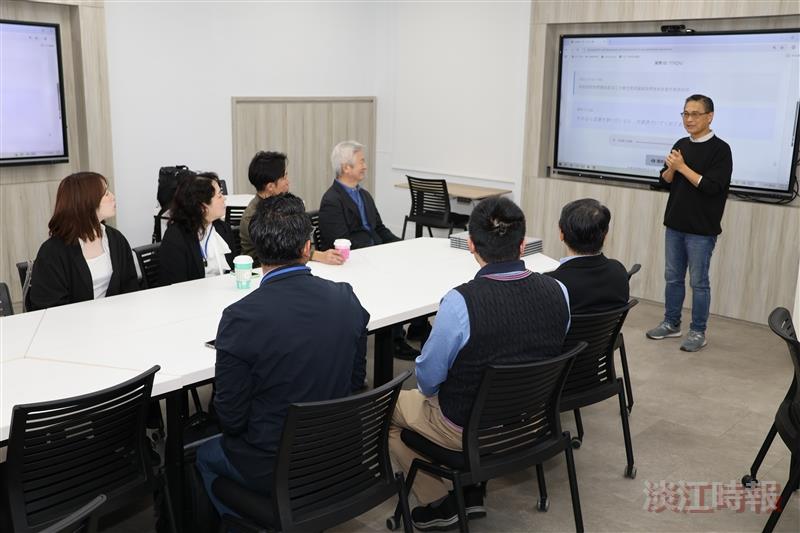
Dean Tzung-Hang Lee (far right) of the College of Artificial Innovative Intelligence was the key figure in making this workshop possible.
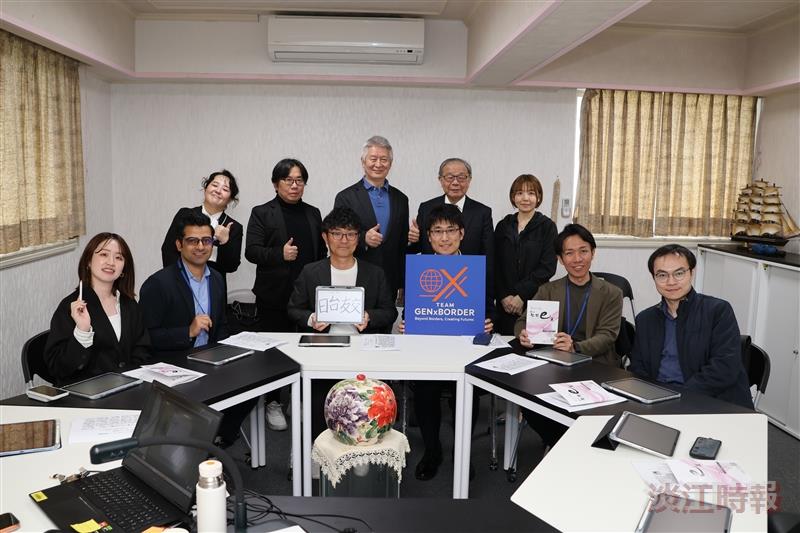
KTVI members visited the Calligraphy Research Room and, under the guidance of Ben-Hang Chang (back row, right 2nd), Director of the Carrie Chang Fine Arts Center, experienced writing with the “Smart e-Pen.”
LINKS
- PREV:Tamkang University Partners with Microsoft, AMD, FET, and the Big Three Accounting Firms to Advance Dual-Track Talent Development in AI and Sustainability 2026-03-04
- NEXT:Po-Shen Pan’s Boron Compound Patent Licensed to Genhealth Pharma to Advance New Cancer Drug Development 2026-03-06
- Alumna’s Fluent Japanese Featured in Japanese Media, TKU Japanese Department Invites Prospective Students to Follow TSMC into Japan 2026-03-16
- College of Education Partners with University of Osaka to Advance Cross-Border Collaboration on Futures Research and Social Innovation 2026-03-12
- President Keh Leads Delegation to Visit AMD, Aiming to Deepen Industry–Academia Collaboration and Cultivate Interdisciplinary AI Talent 2026-03-11
- Department Expo Draws Over a Thousand as Students “Chase the Light” at Tamkang University 2026-03-10
- Kyushu–Taiwan Visionary Institute Corporate Delegation Visits Tamkang, One-Day AI Workshop Sparks Collaboration Opportunities 2026-03-09
- Po-Shen Pan’s Boron Compound Patent Licensed to Genhealth Pharma to Advance New Cancer Drug Development 2026-03-06
- Onomichi High School Study Group from Japan Visits Tamkang University, Fostering Cross-Cultural Exchange with Local Student Partners 2026-03-06
- Tamkang University Partners with Microsoft, AMD, FET, and the Big Three Accounting Firms to Advance Dual-Track Talent Development in AI and Sustainability 2026-03-04
- Delta Donates NT$30 Million Digital Twin Platform to Tamkang to Cultivate Smart Manufacturing Talent 2026-02-26
- Le Corbusier World Touring Exhibition Opens in Taiwan at Tamkang University, Where Tamkang Community Composes a Poetic Dialogue of Modern Art and Architecture 2026-02-26