News and Events
Po-Shen Pan’s Boron Compound Patent Licensed to Genhealth Pharma to Advance New Cancer Drug Development
Date 2026-03-06 53 Clicks

A patented technology jointly developed by Chemistry Professor Po-Shen Pan, Chemistry alumnus Shuo-Pei Chiu, and physician Yi-Wei Chen of Taipei Veterans General Hospital has recently been successfully licensed to Genhealth Pharma with support from the University’s Office of Research and Development. The transferred technology, titled “Method for Preparing Tetraboronic Compounds and Tetraboronic Compounds,” will serve as the foundation for an upcoming industry–academia collaboration aimed at developing boron-containing drugs for cancer treatment.
Prof. Pan’s research team has long been dedicated to anticancer drug development, with a focus on the synthesis of boron-containing compounds. Conventional boron compounds typically rely on multi-step organic synthesis, which is complex, costly, and prone to damaging key boronic functional groups. In response to clinical and industrial needs, the team proposed an innovative combinatorial synthesis strategy that enables the direct construction of four boronic functional groups onto a target drug molecule under a single reaction condition, significantly simplifying the process while enhancing molecular stability.
The technology was granted patents in both Taiwan and the United States in 2020, and later received a Gold Medal at the invention competition of the 2023 Taiwan Innotech Expo. Prof. Pan, who also serves as Dean of Research and Development, noted that patent applications must balance technical disclosure with flexible protection scope to effectively safeguard research results. Throughout the process, the Office of Research and Development assisted in patent evaluation, coordination with patent attorneys, and strategic planning of application procedures, allowing the team to focus on advancing the core technology. After securing the patent, the team enhanced the technology’s visibility through invention exhibitions, ultimately facilitating collaboration with Genhealth Pharma and initiating subsequent drug development plans following the technology transfer.
“Successfully completing this technology transfer not only reflects the team’s technical efforts and the support of the department’s facilities, but also highlights the strength of Tamkang University’s institutional support system,” Pan emphasized. He noted that patents are not the endpoint of research, but rather a critical bridge connecting academic outcomes with industrial applications. With standardized procedures and support from the Office of Research and Development, faculty members can follow clear processes for patent applications and technology transfer, reducing procedural uncertainties while enhancing opportunities to secure large-scale or integrated projects. Through patent protection and industry–academia collaboration mechanisms, research results can be effectively translated into real-world products, amplifying the societal impact of academic research.
SDGs #SDG04 Quality Education #SDG09 Industry, Innovation and Infrastructure #SDG17 Partnerships for the Goals
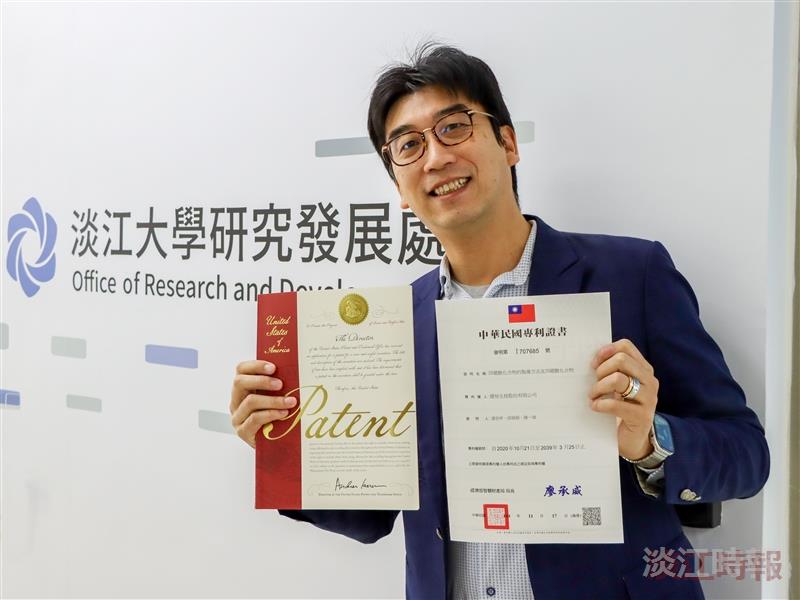
The patented technology developed by the research team led by Chemistry Professor Po-Shen Pan has been granted patents in both Taiwan and the United States, and has been successfully licensed to Genhealth Pharma.
LINKS
- PREV:Kyushu–Taiwan Visionary Institute Corporate Delegation Visits Tamkang, One-Day AI Workshop Sparks Collaboration Opportunities 2026-03-09
- NEXT:Onomichi High School Study Group from Japan Visits Tamkang University, Fostering Cross-Cultural Exchange with Local Student Partners 2026-03-06
- Alumna’s Fluent Japanese Featured in Japanese Media, TKU Japanese Department Invites Prospective Students to Follow TSMC into Japan 2026-03-16
- College of Education Partners with University of Osaka to Advance Cross-Border Collaboration on Futures Research and Social Innovation 2026-03-12
- President Keh Leads Delegation to Visit AMD, Aiming to Deepen Industry–Academia Collaboration and Cultivate Interdisciplinary AI Talent 2026-03-11
- Department Expo Draws Over a Thousand as Students “Chase the Light” at Tamkang University 2026-03-10
- Kyushu–Taiwan Visionary Institute Corporate Delegation Visits Tamkang, One-Day AI Workshop Sparks Collaboration Opportunities 2026-03-09
- Po-Shen Pan’s Boron Compound Patent Licensed to Genhealth Pharma to Advance New Cancer Drug Development 2026-03-06
- Onomichi High School Study Group from Japan Visits Tamkang University, Fostering Cross-Cultural Exchange with Local Student Partners 2026-03-06
- Tamkang University Partners with Microsoft, AMD, FET, and the Big Three Accounting Firms to Advance Dual-Track Talent Development in AI and Sustainability 2026-03-04
- Delta Donates NT$30 Million Digital Twin Platform to Tamkang to Cultivate Smart Manufacturing Talent 2026-02-26
- Le Corbusier World Touring Exhibition Opens in Taiwan at Tamkang University, Where Tamkang Community Composes a Poetic Dialogue of Modern Art and Architecture 2026-02-26