News and Events
Physics Faculty and Students Achieve Breakthrough Surge in Research Output, with Publications in Leading International Journals
Date 2026-04-20 15 Clicks

The Department of Physics has recently continued to demonstrate strong research capabilities. Faculty members and students, in collaboration with leading international teams, have achieved significant breakthroughs in materials science, quantum physics, and high-performance computing. Their research results have been published in prestigious international journals, with some featured on journal covers, and have also been shortlisted for the ACM Gordon Bell Prize, often regarded as the “Nobel Prize of supercomputing.”
Lithium Battery Breakthrough: Hsiao-Tsu Wang Team Unveils High-Voltage Stability Mechanism
Amid the rapid expansion of green energy transition and the electric vehicle industry, improving battery energy density and lifespan has become a central focus of global scientific research. Associate Professor Hsiao-Tsu Wang from the Department of Physics led first-year graduate students Yi-Hong Chang and Chi-Feng Lee, in collaboration with Distinguished Chair Professor Way-Faung Pong, to conduct an in-depth study on lithium-rich manganese-based (LMR) cathode materials. The research was published in the prestigious international journal ACS Applied Materials & Interfaces (impact factor 8.2) and was selected as a cover article.
Although LMR materials are considered promising for enhancing energy density, they have long faced challenges such as oxygen release and structural degradation under high-voltage operation. The key breakthrough of Wang’s team lies in utilizing the Scanning Transmission X-ray Microscopy (STXM, TPS 27A1) beamline, jointly established by Tamkang University and the National Synchrotron Radiation Research Center (NSRRC). With nanoscale spatial resolution, the team was able, for the first time, to directly observe subtle differences in the electronic structure between the particle surface and interior.
Wang explained that the study identified a “π-type superexchange” spin-exchange mechanism formed in surface-modified materials. This mechanism establishes a more stable electronic coupling pathway, effectively suppressing unstable reactions during redox processes and significantly enhancing high-voltage stability.
The critical STXM data and conclusions of this study were all generated at TPS 27A1. Wang expressed gratitude for Tamkang’s strong research environment and gave special thanks to Way-Faung Pong for his contributions to the beamline's construction and technical guidance, as well as to Assistant Researcher Hung-Wei Shiu from NSRRC, also an alumnus of the Department of Physics, for his efforts in both construction and experimentation. This Taiwan–U.S. collaborative research successfully connected the battery R&D division of General Motors with the Department of Materials Science & Engineering at the University of Michigan, integrating industrial application needs with fundamental electronic structure analysis. Spanning material design, electrochemical testing, and advanced nanoscale synchrotron studies, the project established a comprehensive international research framework. It provided critical parameters for the design of next-generation high-energy-density batteries.
Participating students Yi-Hong Chang and Chi-Feng Lee noted that although the research process was complex and required countless rounds of validation, seeing their work featured on the cover of an international journal brought immense satisfaction and further strengthened their commitment to pursuing research careers.
New Frontiers in Quantum Materials: Hung-Chung Hsueh, Chih-En Hsu Lead Theoretical Innovation
In the fields of quantum materials and low-dimensional electronic systems, Professor Hung-Chung Hsueh and alumnus and postdoctoral researcher Chih-En Hsu have collaborated with international teams to produce a series of significant research breakthroughs. Working with the University of Southern California (USC) and National Taiwan University, they published two major studies on novel physical mechanisms involving Wigner crystal excitons and atomic-scale MoS₂ plasmons.
First, in collaboration with Professor Zhenglu Li of USC, they published their work in the Proceedings of the National Academy of Sciences (impact factor 10.6), revealing the formation mechanism of generalized Wigner-crystal excitons in moiré heterostructure systems. Using advanced first-principles GW many-body perturbation theory calculations, the study accurately captured the crystallized states of electron–hole pairs under strong Coulomb interactions. It demonstrated that, through modulation of superlattice potentials, excitonic states can remain stable at room temperature and exhibit excellent optoelectronic properties, opening new pathways for optoelectronic sensors and tunable quantum materials.
Subsequently, together with recent graduate Yung-Ning Hsu and the experimental team led by Director Ming-Wen Chu of NTU’s Center for Condensed Matter Sciences, they published another study in Physical Review Research (impact factor 4.4). This work revealed that monolayer atomic-scale MoS₂ exhibits ultrafast long-wavelength plasmon propagation, deepening understanding of plasmon physics in low-dimensional materials and offering strong potential for the development of high-speed terahertz detectors and nanophotonic devices.
Beyond theoretical innovation, Hsu has also made history in the field of high-performance computing (HPC). As a key member of the BerkeleyGW team, he contributed to achieving a breakthrough computing performance of 1.069 ExaFLOP/s on the Frontier supercomputer at Oak Ridge National Laboratory and the Aurora supercomputer at Argonne National Laboratory.
Professor Hsueh noted that the research simulated electron–phonon coupling many-body problems involving more than 17,000 atoms and was shortlisted for the prestigious ACM Gordon Bell Prize. Hsu is the first Taiwanese scholar ever to be shortlisted for this award. This achievement not only demonstrates the international competitiveness of Tamkang University’s physics research in supercomputing simulations but also provides strong momentum for future studies in superconductors and strongly correlated systems.
Breakthrough in Nanomaterial Band Structure: Chi-Cheng Lee Publishes in Nano Letters
Associate Professor Chi-Cheng Lee of the Department of Physics collaborated with Assistant Professor Naoya Yamaguchi and Professor Fumiyuki Ishii of Kanazawa University, as well as Professor Taisuke Ozaki of the University of Tokyo, to publish a joint study in the leading international journal Nano Letters (impact factor 9.9). The team proposed a new method called “Giant Molecule Band Unfolding,” which enables the reconstruction of band structures in nanomaterials.
The study reveals that the electronic structure of nanomaterials exhibits “band-like” characteristics similar to infinitely extended systems—akin to the quantum-scale amplification seen in the film Ant-Man. According to Lee, the concept behind this research, described as “a decade in the making”, dates back more than ten years. Beginning with the design of basis functions and progressing through software development, he and Naoya Yamaguchi advanced the work over a long period before successfully establishing this new method.
SDGs #SDG04 Quality Education #SDG09 Industry, Innovation and Infrastructure #SDG17 Partnerships for the Goals
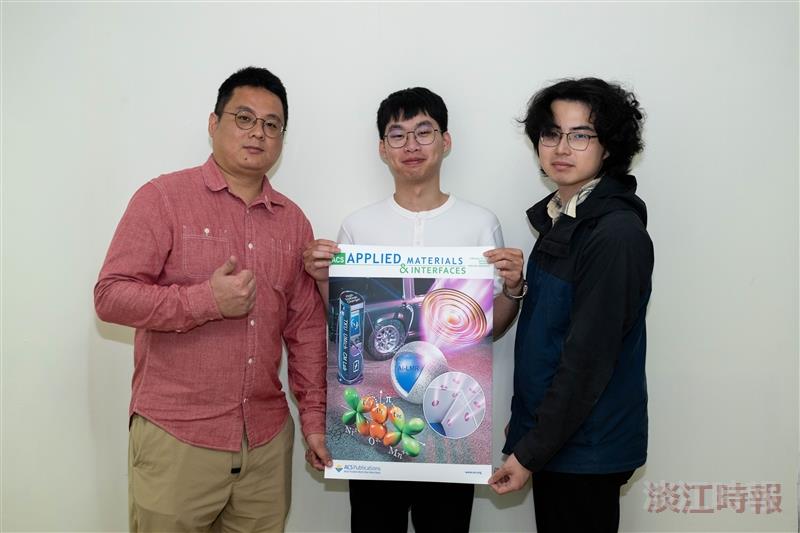
Associate Professor Hsiao-Tsu Wang of the Department of Physics (left) led first-year master’s students Chi-Feng Lee and Yi-Hong Chang in research on “lithium-rich manganese-based” cathode materials, with their results published in the internationally renowned journal ACS Applied Materials & Interfaces and selected as the cover article.
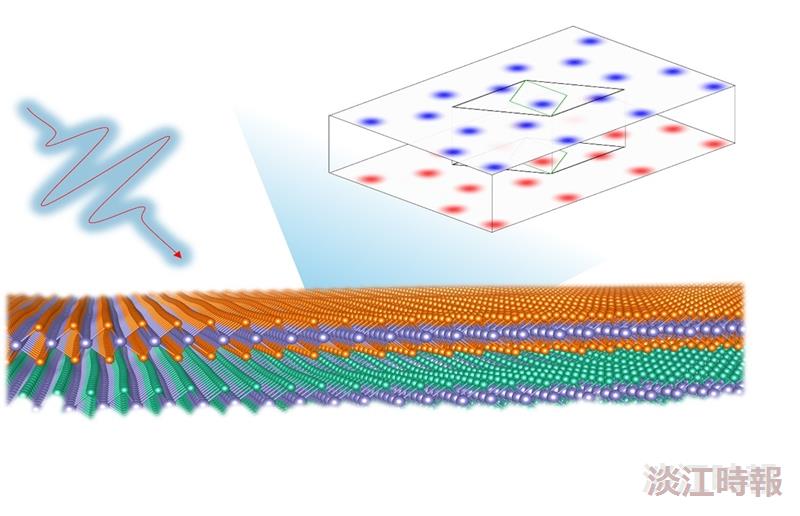
Research by Professor Hung-Chung Hsueh of the Department of Physics and alumnus/postdoctoral researcher Chih-En Hsu visualizes the photoexcitation process and wave propagation, indicated by arrows, presenting theoretically predicted crystallized excitons and illustrating a significant innovative breakthrough.
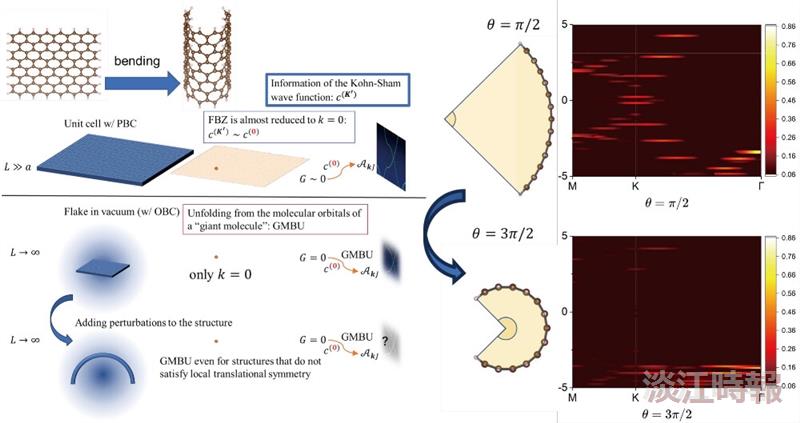
Associate Professor Chi-Cheng Lee of the Department of Physics collaborated with Japanese scholars on an international research project, applying a newly developed method to analyze the band structure of curved systems.
LINKS
- PREV:Tamkang University Deepens Industry–Academia Partnership with AMD, Focusing on AI Curriculum, Robotics, and Campus Computing Infrastructure 2026-04-17
- NEXT:USR Banquet Program Launches “Huwei Feast 1002”: Press Event Tells History Through Cuisine 2026-04-20
- Scholars from 14 Countries Gather at ICEIB 2026 at Tamkang University to Explore Key Opportunities in the AI Wave 2026-04-27
- Physics Faculty and Students Achieve Breakthrough Surge in Research Output, with Publications in Leading International Journals 2026-04-20
- USR Banquet Program Launches “Huwei Feast 1002”: Press Event Tells History Through Cuisine 2026-04-20
- From Professional Support to Witnessing the Completion of the Danjiang Bridge, Tamkang University Demonstrates the Value of a Locally Engaged Institution 2026-04-20
- Tamkang University Deepens Industry–Academia Partnership with AMD, Focusing on AI Curriculum, Robotics, and Campus Computing Infrastructure 2026-04-17
- President Keh Boosts Morale at National Intercollegiate Athletic Games Flag Presentation, Soft Tennis Team Secures 3 Silvers in Early Victory 2026-04-15
- AI–Sustainability Dual Governance: President Huan-Chao Keh Wins CommonWealth Magazine Outstanding Performance Award in Peer Evaluation 2026-04-15
- Science Outreach Travels 3,000 Km Overseas: “Chemistry On The Go” Officially Launches in Malaysia 2026-04-09
- Honors Program ‘Sustainable Design and Innovation’ Guides Students in Social Practice, Wins Global Views USR Award 2026-04-09
- International Student Eco-Culture Expo: 8 Student Clubs Promote Global Sustainability Concepts 2026-03-31