News and Events
Scholars from 14 Countries Gather at ICEIB 2026 at Tamkang University to Explore Key Opportunities in the AI Wave
Date 2026-04-27 13 Clicks

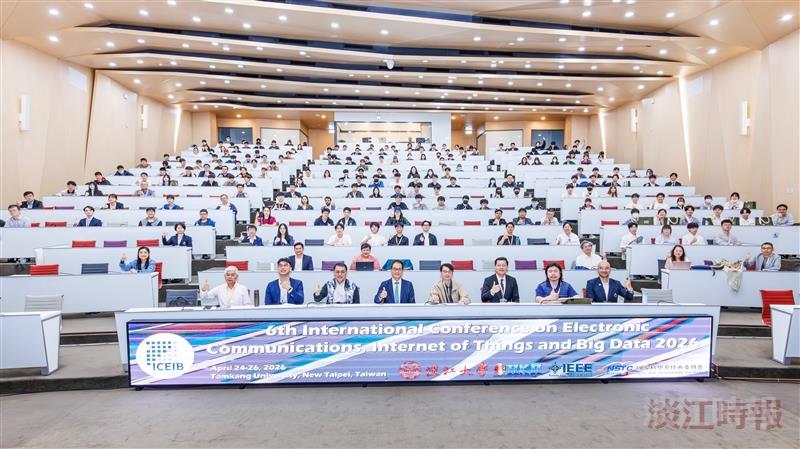
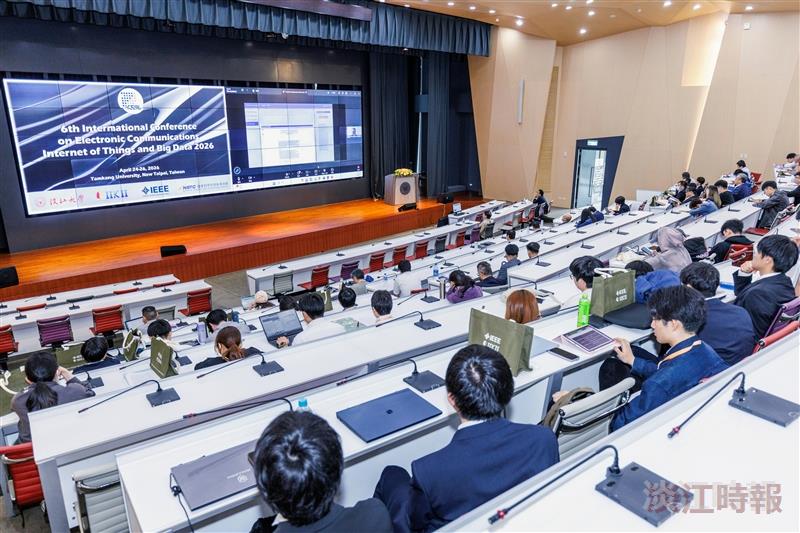
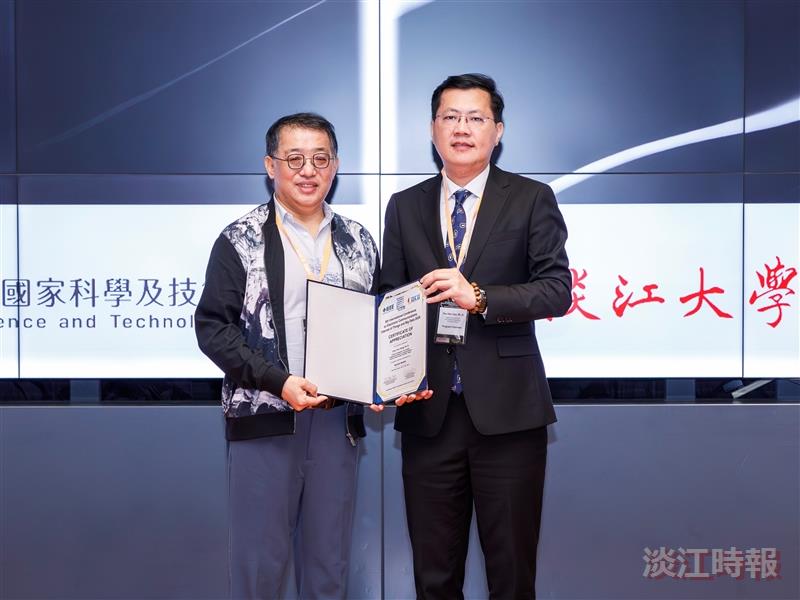
The 2026 IEEE 6th International Conference on Electronics Communications, Internet of Things, and Big Data (ICEIB 2026) was held from April 24 to 26 at the Hsu Shou-Chlien International Conference Center, Chang Yeo Lan International Conference Hall, at Tamkang University. The event was jointly organized by the university, the IEEE Tainan Section Sensors Council (IEEE Tainan Section Sensors Council), and the International Institute of Knowledge Innovation and Invention (International Institute of Knowledge Innovation and Invention), with funding support from Taiwan’s National Science and Technology Council. In addition to distinguished guests from Taiwan and abroad, more than 200 participants from industry, government, and academia attended, engaging in discussions on artificial intelligence and sustainable development.
The conference adopted a hybrid format, with participants joining both in person and online from Taiwan, the United States, Japan, South Korea, India, Israel, Malaysia, China, the Philippines, Bahrain, Ecuador, Ghana, Pakistan, and Thailand. During the opening ceremony, Honorary Chair and Academic Vice President Hui-Huang Hsu of Tamkang University welcomed attendees and expressed appreciation for their support and participation.
In response to the impact of the AI era on education, two keynote speeches focused on the influence of AI technologies on learning. Professor Chun-Yen Chang of National Taiwan Normal University delivered a talk titled “From Clickers to AI: A Personal Journey in Transforming Science Learning,” sharing the evolution of science education over the past three decades—from early CloudClassRoom (CCR) to Adaptive Interactive Study Interface (AISI) integrated with generative AI. He emphasized how AI systems can guide learners toward deeper scientific reasoning through metacognitive prompts. Meanwhile, Associate Professor Pantelis M. Papadopoulos of the University of Twente presented online on “Agnoagentia: From Cognitive Offloading to Cognitive Surrender, and the Illusion of Student Agency in Using Generative AI in Education.” He noted that excessive and uncritical reliance on technology may lead to cognitive surrender, highlighting the gap between perceived and actual student agency.
Conference organizer and Chair, Associate Professor Shu-Han Liao from the Department of Electrical and Computer Engineering at Tamkang University, expressed hope that through academic exchange amid the current AI wave, new research ideas will be sparked, enabling Taiwan to seize key opportunities and contribute to industry development. ICEIB continues to serve as a high-quality platform for researchers and professionals in electronics communications, IoT, and big data. This year, the conference received 223 submissions, with 158 papers accepted for presentation. The selected papers span seven major themes, covering a wide range of advanced technologies and practical applications, including big data and cloud computing, AI technologies and applications, robotics science and engineering, IoT and sensor technologies, electrical and electronic engineering, big data and AI applications in civil and architectural engineering, as well as environmental engineering and geographic information systems. Outstanding papers will be selected and recommended for publication in over 20 SSCI, SCI, and Scopus-indexed journals, including Computer Modeling in Engineering & Sciences, Biomimetics, and Sensors.
SDGs #SDG04 Quality Education #SDG09 Industry, Innovation and Infrastructure #SDG17 Partnerships for the Goals
LINKS
- PREV:From Professional Support to Witnessing the Completion of the Danjiang Bridge, Tamkang University Demonstrates the Value of a Locally Engaged Institution 2026-04-20
- Scholars from 14 Countries Gather at ICEIB 2026 at Tamkang University to Explore Key Opportunities in the AI Wave 2026-04-27
- Physics Faculty and Students Achieve Breakthrough Surge in Research Output, with Publications in Leading International Journals 2026-04-20
- USR Banquet Program Launches “Huwei Feast 1002”: Press Event Tells History Through Cuisine 2026-04-20
- From Professional Support to Witnessing the Completion of the Danjiang Bridge, Tamkang University Demonstrates the Value of a Locally Engaged Institution 2026-04-20
- Tamkang University Deepens Industry–Academia Partnership with AMD, Focusing on AI Curriculum, Robotics, and Campus Computing Infrastructure 2026-04-17
- President Keh Boosts Morale at National Intercollegiate Athletic Games Flag Presentation, Soft Tennis Team Secures 3 Silvers in Early Victory 2026-04-15
- AI–Sustainability Dual Governance: President Huan-Chao Keh Wins CommonWealth Magazine Outstanding Performance Award in Peer Evaluation 2026-04-15
- Science Outreach Travels 3,000 Km Overseas: “Chemistry On The Go” Officially Launches in Malaysia 2026-04-09
- Honors Program ‘Sustainable Design and Innovation’ Guides Students in Social Practice, Wins Global Views USR Award 2026-04-09
- International Student Eco-Culture Expo: 8 Student Clubs Promote Global Sustainability Concepts 2026-03-31