News and Events
Aerospace Engineering Team Led by Yi-Ren Wang Dominates Green Invention Competition for Second Straight Year, Wins Top Platinum Award Again
Date 2026-08-04 83 Clicks

A faculty-student team led by Professor Yi-Ren Wang of Tamkang University’s Department of Aerospace Engineering recently competed in the 2026 Green Idea Invention and Design Fair, held at Cheng Shiu University in Kaohsiung. Their project, “AI-Optimized Acoustic Black Hole Device for Vibration Reduction and Piezoelectric Energy Harvesting,” stood out among 193 competing teams and won the event’s highest honor, the Platinum Award, marking the team’s second consecutive victory.
The award-winning device uses an Acoustic Black Hole (ABH) structure to concentrate vibration energy, which is then converted into electrical energy through piezoelectric elements. By combining vibration suppression with energy harvesting, the technology offers potential applications for powering low-power sensors in bridges, rail transportation systems, unmanned aerial vehicles, aerospace structures, and other engineering systems.
Prof. Wang explained that a key innovation of the project is the integration of engineering optimization into an AI-based design process. The team developed its own database based on physical models and compared algorithms including DNN, LSTM, and XGBoost. The resulting model accurately predicted that positioning the ABH vibration-reduction beam at approximately the midpoint of the main beam would provide optimal performance, significantly reducing the time required for the repetitive simulations and experiments used in conventional design methods.
Unlike many teams that simply apply existing AI software, the Tamkang aerospace team developed and trained customized predictive models based on physical and experimental data. Their work represents a pioneering effort in Taiwan to integrate acoustic black holes, piezoelectric energy harvesting, and AI-based optimization. By transforming otherwise undesirable vibration into green energy, the project closely aligns with Tamkang University’s commitment to AI and sustainable development while demonstrating an interdisciplinary integration of green technology and aerospace engineering.
The award-winning students are members of Professor Wang’s NVIDIA Laboratory (Nonlinear Vibration Investigation and Damping Innovation Authority). The project builds on the master’s thesis of this year’s graduate Chen-Yen Yu, extending its simulation and experimental work through machine learning and broader applications. Team members Te-Liang Ou, Hao-Yu Wang, You-Jeng Hung, and Ya-Han Yeh are master’s students, while Chia-Mei Lin and Yi-Ching Huang are undergraduate project students entering their senior year.
SDGs #SDG04 Quality Education #SDG07 Affordable and Clean Energy #SDG09 Industry, Innovation and Infrastructure #SDG17 Partnerships for the Goals
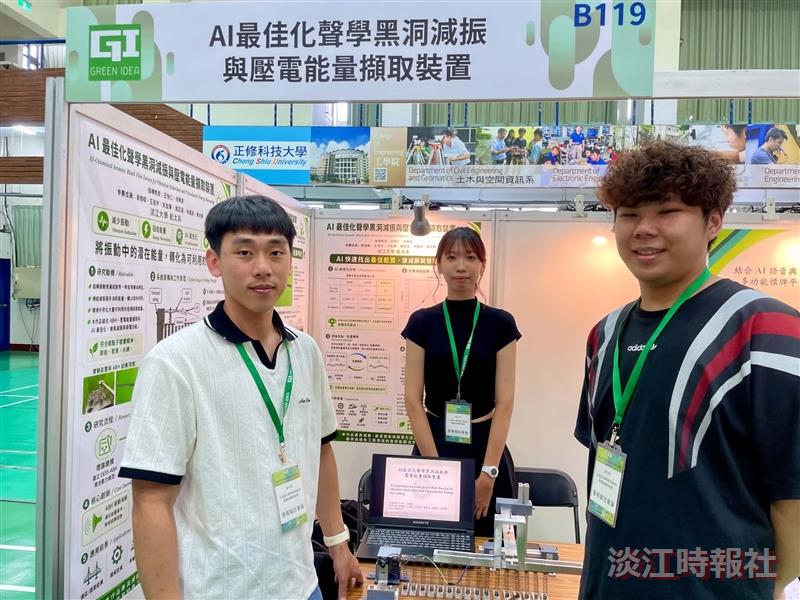
Members of Tamkang University’s Department of Aerospace Engineering competition team pose in front of their project booth. From left: Te-Liang Ou, Chia-Mei Lin, and Hao-Yu Wang.
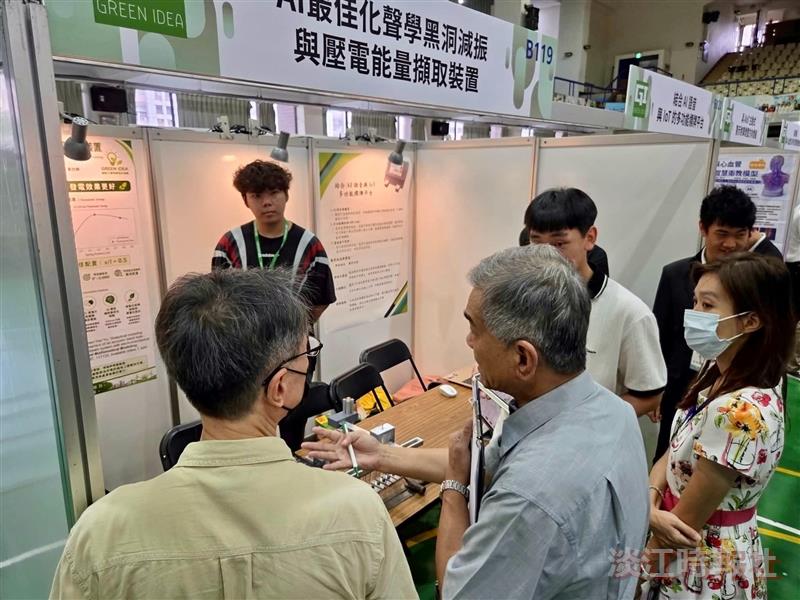
Professor Yi-Ren Wang (first from left) of the Department of Aerospace Engineering explains the principles and applications of the team’s project to the judging panel. At center is the competition’s chief judge, Distinguished Professor Hung-Duen Yang of National Sun Yat-sen University.
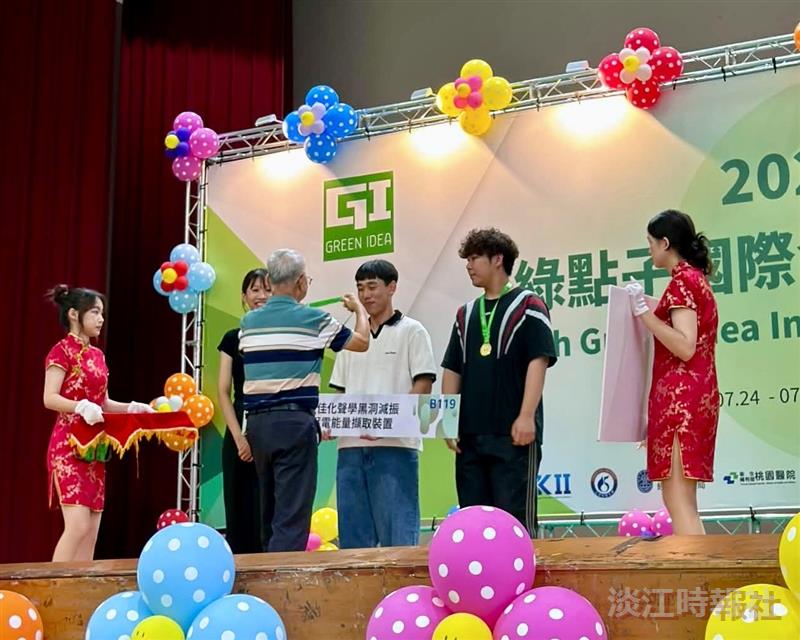
Representatives of Tamkang University’s Department of Aerospace Engineering team take the stage to receive the Platinum Award.
LINKS
- PREV:Aerospace Engineering’s Stargazer Rocket Successfully Launched in Special Finale at Taiwan Cup Rocket Competition 2026-08-03
- Aerospace Engineering Team Led by Yi-Ren Wang Dominates Green Invention Competition for Second Straight Year, Wins Top Platinum Award Again 2026-08-04
- Aerospace Engineering’s Stargazer Rocket Successfully Launched in Special Finale at Taiwan Cup Rocket Competition 2026-08-03
- Tamkang University and Deloitte Sign MOU to Cultivate Talent in AI, Sustainability, and Digital Transformation 2026-07-29
- Office of Student Affairs Leads Students on Gongliao Field Trip to Experience Local Culture and Explore Regional Revitalization 2026-07-29
- 30 Faculty Members Earn AI Project Application Certification After Completing Intensive Summer Training 2026-07-08
- Tamkang Ranks No. 1 Among Private Universities in Business and Management Peer Assessment in Global Views Monthly’s 2026 Taiwan Best Universities Rankings 2026-07-06
- Ben-Hang Chang Awarded Japan’s Order of the Rising Sun, Gold Rays with Rosette, in Recognition of Advancing Taiwan–Japan Exchanges 2026-06-16
- EU Diplomats Gather in Tamsui to Experience the Hobe Banquet, Rekindling the Legacy of the Sino-French War Through Academic Diplomacy 2026-06-12
- International Students Celebrate the Dragon Boat Festival with Rice Dumplings and Taiwanese Traditions 2026-06-12
- Tamkang University Paves Graduates’ Path with Intelligence and Sustainability, Chuan-Sheng Chien and Tzu-Hua Chuang Encourage Students to Shape Infinite Possibilities Through Their Future Selves 2026-06-06