News and Events
MOE Joins Forces with Tamkang University and 3 Other Universities to Launch Immersive Technology Program for Competency-Based Learning in 12-Year Basic Education
Date 2026-04-22 21 Clicks

In alignment with the vision of “Smart Nation 2.0” and emerging technologies such as AI, augmented reality (AR), virtual reality (VR), and the educational metaverse, the launch meeting and workshop for the “2026 Immersive Technology Integration into Competency-Oriented Teaching Program,” guided by the Department of Information and Technology Education of the Ministry of Education, was held at 9:00 a.m. on April 22 in the International Conference Hall on the second floor of Tamkang University’s Taipei Campus. Project teams and representatives from core schools across Taiwan gathered for the event, including principals from 10 primary and secondary schools and approximately 113 participants, marking a new chapter in Taiwan’s next-generation smart learning environment.
The project is led by the Department of Educational Technology at Tamkang University as the principal coordinating institution, in collaboration with National University of Kaohsiung (NUK), National Tsing Hua University (NTHU), and University of Taipei (UTaipei). The initiative aims to shift immersive technologies from experimental applications toward systematic integration and sustainable development, thereby deepening Taiwan’s educational digital transformation. The project team is led by Principal Investigator (PI) Hsin-Yi Shyu, Professor in the Department of Educational Technology at Tamkang University, who oversees curriculum development. Co-PIs include Associate Professor Cheng-Hung Wang of NUK, responsible for developing the educational metaverse platform; Professor Chiu-Pin Lin of National Tsing Hua University, in charge of demonstration teaching and instructional support; and Professor Yi-Hsuan Wang of UTaipei, responsible for campus implementation and learning outcome assessment.
Senior Administrator Yen-Chen Lin of the Department of Information and Technology Education at MOE remarked that immersive technology and the metaverse play an essential role in the nation’s smart development strategy, and that the Executive Yuan has high expectations for the program. She explained that the initiative focuses on two key immersive technologies: VR and the metaverse, each serving different educational purposes. VR teaching materials allow students to experience environments difficult to access in traditional classrooms, such as observing microscopic molecules and atoms, exploring deep-sea ecosystems, or traveling through outer space and the solar system, “making invisible or unreachable phenomena vividly accessible to students.” She also noted that all 76 participating partner schools are required this year to join the “Educational Metaverse Platform,” which will be upgraded to support large-scale participation, while encouraging close collaboration between elementary and high schools and university professors.
Hsin-Yi Shyu explained that the project builds upon Taiwan’s recent digital infrastructure initiatives under the Forward-looking Infrastructure Development Program. By integrating the expertise of leading educational technology scholars from domestic universities, the project seeks to incorporate immersive technology industries into the 12-year basic education and further advance educational digital transformation. Unlike previous large-scale projects involving hundreds of schools, Shyu emphasized that the 30 selected core schools participating this year are “the elite among the elite.” She noted that the program carries a strong experimental and innovative research character, and that the implementation results of participating teachers this year will serve as important benchmarks and demonstration models for schools joining in future phases.
Shyu further described VR and the metaverse as the project’s “dual engines.” VR can overcome physical limitations and safety concerns while transforming abstract knowledge into concrete experiences, thereby promoting opportunities for inquiry and hands-on learning. The metaverse, meanwhile, provides a digitally integrated virtual-physical twin environment designed to facilitate student collaboration and connection. She stressed that future teaching approaches will move beyond isolated VR teaching materials toward issue-oriented curriculum modules emphasizing interdisciplinary problem-solving capabilities. She also likened elementary and high school educators to “designers” and university teams to “engineers,” expressing hope that both sides will collaborate closely in developing and testing new educational applications.
Following the launch ceremony, project leaders provided implementation briefings for representatives from the 76 partner schools. In the afternoon, a meeting for learning outcome assessment personnel was held, followed by an interdisciplinary curriculum design and design thinking workshop led by Professor Ming-Feng Chan of National Central University.
SDGs #SDG04 Quality Education #SDG09 Industry, Innovation and Infrastructure #SDG17 Partnerships for the Goals
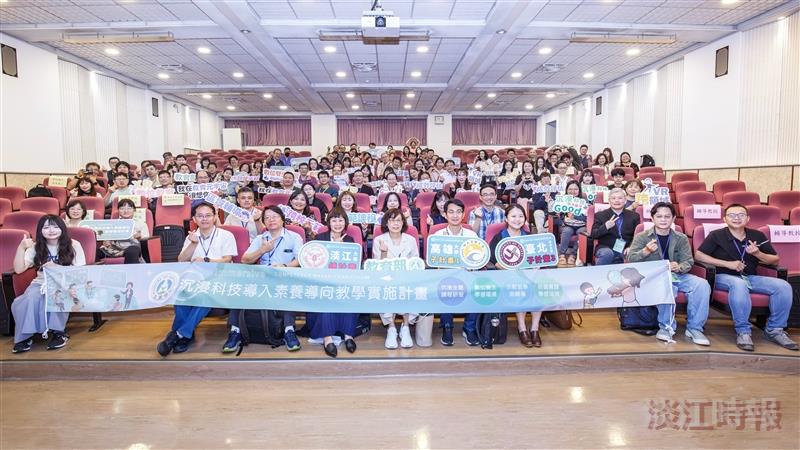
Group photo of all participants at the program launch meeting.
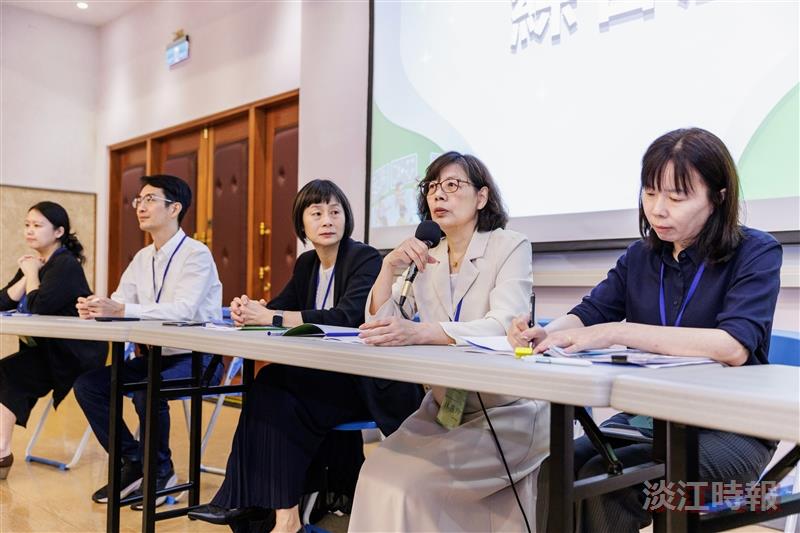
Senior Administrator Yen-Chen Lin of the Department of Information and Technology Education of MOE moderated the panel discussion.
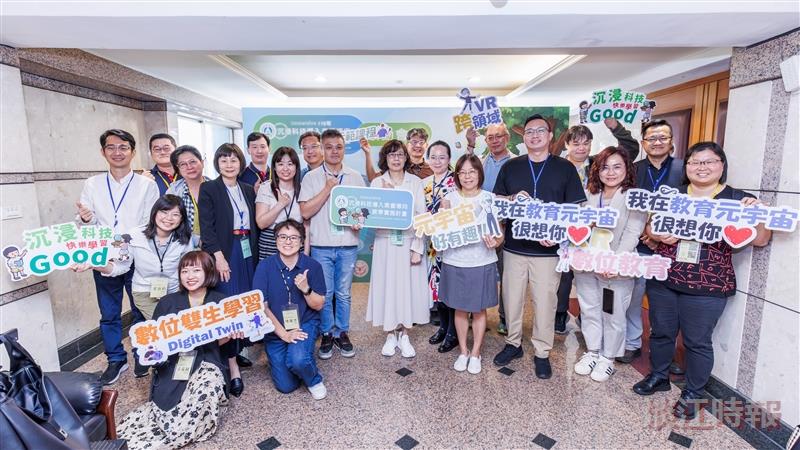
Representatives from the Department of Information and Technology Education of MOE, project teams from the four participating universities, and delegates from primary and secondary schools pose for a group photo.
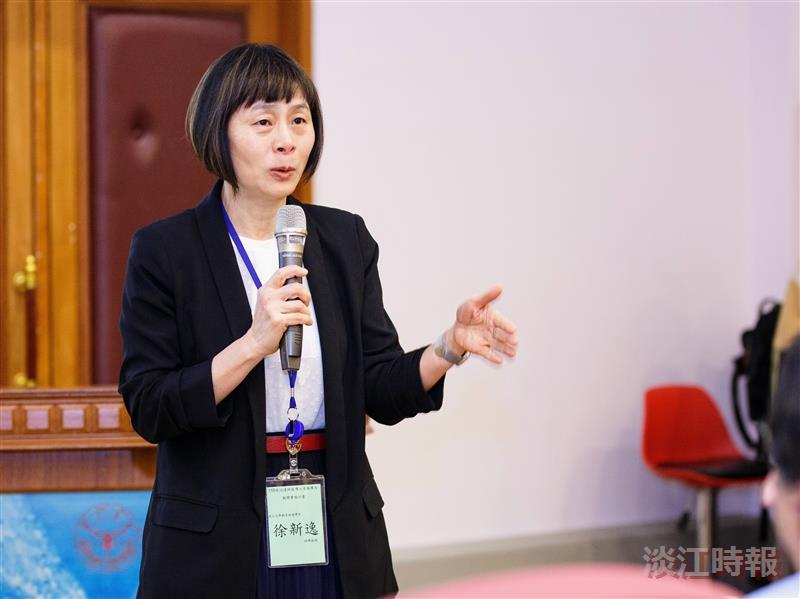
Hsin-Yih Shyn delivers remarks.
LINKS
- PREV:From Professional Support to Witnessing the Completion of the Danjiang Bridge, Tamkang University Demonstrates the Value of a Locally Engaged Institution 2026-04-20
- NEXT:Tamkang University Brings ‘Chemistry On The Go’ to Malaysia, Launches International Science Outreach Collaboration with Universiti Tunku Abdul Rahman 2026-04-22
- President and Vice President Send Congratulatory Messages to Celebrate Launch of Tamkang University’s “Huwei Banquet 1002” Event 2026-05-02
- Distinguished Research Chair Professor Jong-Shenq Guo from Math Department Awarded Merit Research Fellow by National Science and Technology Council 2026-04-30
- Ben-Hang Chang Honored with Japan’s Order of the Rising Sun for Promoting Taiwan–Japan Calligraphy Exchange 2026-04-30
- Scholars from 14 Countries Gather at ICEIB 2026 at Tamkang University to Explore Key Opportunities in the AI Wave 2026-04-27
- MOE Joins Forces with Tamkang University and 3 Other Universities to Launch Immersive Technology Program for Competency-Based Learning in 12-Year Basic Education 2026-04-22
- Tamkang University Brings ‘Chemistry On The Go’ to Malaysia, Launches International Science Outreach Collaboration with Universiti Tunku Abdul Rahman 2026-04-22
- Physics Faculty and Students Achieve Breakthrough Surge in Research Output, with Publications in Leading International Journals 2026-04-20
- USR Banquet Program Launches “Huwei Feast 1002”: Press Event Tells History Through Cuisine 2026-04-20
- From Professional Support to Witnessing the Completion of the Danjiang Bridge, Tamkang University Demonstrates the Value of a Locally Engaged Institution 2026-04-20
- Tamkang University Deepens Industry–Academia Partnership with AMD, Focusing on AI Curriculum, Robotics, and Campus Computing Infrastructure 2026-04-17